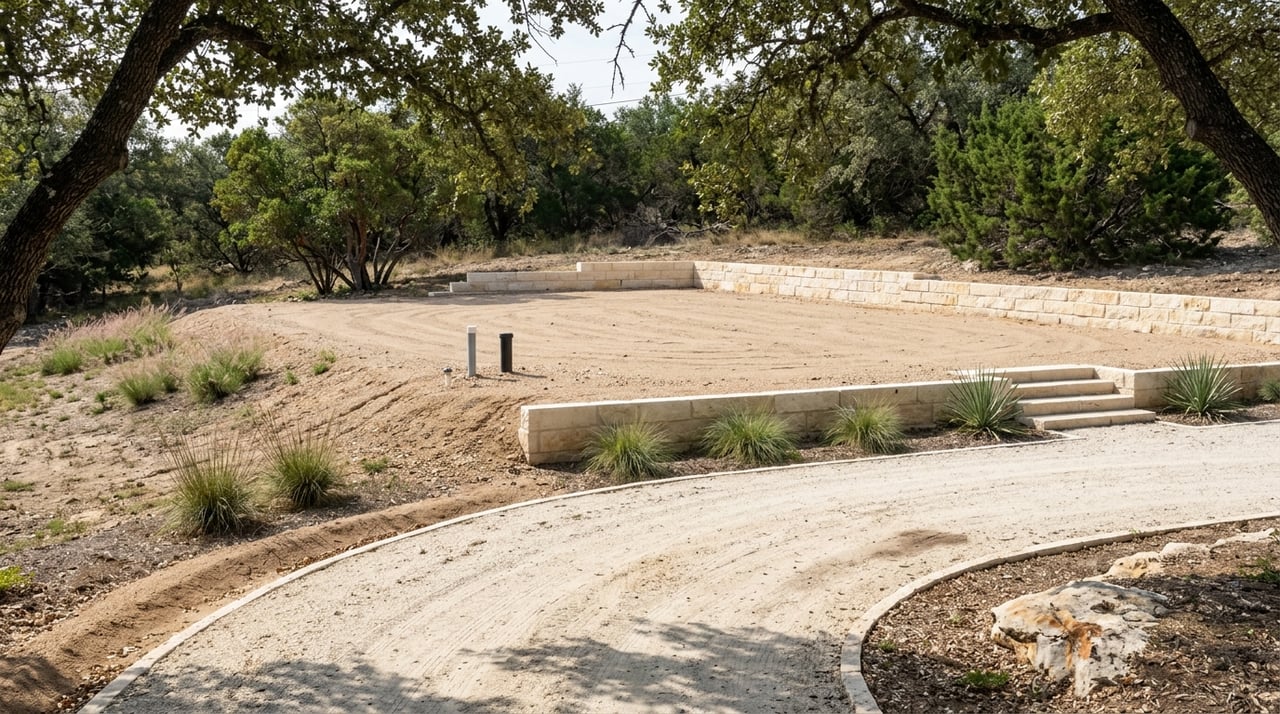
If you are shopping for acreage in Spicewood, the view alone can make a property feel like the one. But in the Hill Country, a beautiful tract and a buildable tract are not always the same thing. When you know how to evaluate access, terrain, utilities, and permit pathways up front, you can make a smarter land decision with fewer surprises later. Let’s dive in.
Why Spicewood homesites need closer review
Spicewood sits in the Texas Hill Country and Edwards Plateau, where the landscape is known for springs, stony hills, steep canyons, shallow limestone soils, and well-drained terrain. That natural character is a big part of the appeal, especially near Lake Travis and places like Pace Bend Park.
It also means the land itself often matters as much as the address. Two properties with similar acreage can have very different building conditions once you map out a house pad, septic area, driveway, and utility routes.
Start with legal buildability
Before you fall in love with a homesite, confirm where it sits from a jurisdiction standpoint. In the Spicewood area, a tract may be inside city limits, in a municipal ETJ, or in unincorporated Travis County, and that affects who handles development review.
Travis County states that a Basic Development Permit is required for land development in unincorporated county areas and in municipal ETJs. If the property is within corporate city limits, development is handled by that municipality instead.
This step matters because the rules are not always obvious from a listing. A parcel that looks straightforward online may have a very specific permit path once you begin planning a build.
County zoning is not the full story
In unincorporated Travis County, zoning usually is not the main issue because the county says most counties, including Travis, do not have zoning authority. In many cases, the real controls come from deed restrictions, subdivision plats, and HOA documents.
That is why a land review should go beyond public-facing marketing. You want to know what the recorded documents allow before you assume you can build a certain home style, guest structure, or future improvement.
Check access before anything else
Access is one of the first items to verify because legal access and usable access are not always the same. A property may have road frontage, an easement, or a route shown on paper, but the actual driveway path and permit requirements can still affect what is realistic.
Travis County says a driveway to a maintained county road requires a county permit. A driveway to a state road requires TxDOT approval, and the county does not issue driveway permits for unmaintained or unaccepted roads.
If the parcel is landlocked or only partially accessible, extra due diligence is essential. The county also asks applicants to show access easements and site-plan details, so you want clarity early, not after closing.
Ask practical driveway questions
A driveway is more than a line on a survey. In Spicewood, you should also think about grade, drainage, turning radius, and how the driveway reaches the best building area.
A long or steep drive can add cost and influence how a homesite functions day to day. It can also affect emergency access, which becomes especially important on larger or more heavily vegetated tracts.
Study the topography, not just the acreage
Topography is one of the biggest hidden cost drivers on Spicewood land. Hill Country terrain can be rugged, and Travis County notes that steeper slopes and work near waterways may trigger added erosion and sediment-control review.
That means a large lot is not automatically an easy lot. If the best views sit beyond steep grades or shallow soils, the cost to create a buildable pad may be higher than expected.
Slope can shape your entire plan
When you review a homesite, think about where the house can actually sit without major cut-and-fill. Also look at where septic, utilities, and driveway access can fit around that same area.
If you hope to clear parts of the lot for a building site or expanded views, Travis County says planned machine clearing can also require a permit. That makes early site planning especially important.
Orientation still matters
On custom-build lots, the way a home sits on the land can shape comfort, privacy, and long-term efficiency. The U.S. Department of Energy says passive solar design uses site and climate to reduce energy use, and that part of a home’s south side should have unobstructed access to the sun.
In practical terms, that means reviewing lot depth, road position, tree cover, and where the best house pad would preserve both light and privacy. On a strong homesite, the land supports the architecture rather than fighting it.
Review drainage and flood exposure early
Flood review should happen at the start of your evaluation, not near the end. This is especially true for land near creeks, drainage swales, low crossings, or the Lake Travis shoreline.
FEMA identifies its Flood Map Service Center as the official source for flood hazard products, and Travis County notes that floodplain jurisdiction applies in unincorporated areas outside city limits. A current flood-map review can help you understand whether a specific building area may face added limits or costs.
Drainage also matters even outside mapped flood zones. In a region with rough, well-drained terrain, water movement across a lot can influence driveway design, erosion control, and where improvements can go.
Understand utilities before you price the build
One of the biggest questions on acreage is whether utilities are public or private. That answer can affect both your timeline and your budget.
For water, TCEQ says public water systems must test regularly and issue annual consumer confidence reports. If the property relies on a private well, the owner is responsible for regular testing.
If the property needs a well
The Texas Water Development Board says initial testing should be done when a new well is installed. It also notes that private wells do not require registration unless the property is inside a groundwater conservation district.
Well placement is just as important as water quality. TWDB states that separation distances include 50 feet from a septic tank, 100 feet from drain fields or spray areas, and 50 feet from an adjacent property line.
Those setbacks are a big reason why a survey and a rough utility plan should happen early. On some lots, the house, well, septic area, and setbacks all compete for the same usable ground.
Confirm the septic path
For many Spicewood homesites, septic is one of the most important pieces of the due diligence process. Travis County says its septic permit process applies to development outside corporate city limits, and any site development permit using an on-site wastewater system requires a separate OSSF application.
The county’s septic checklist asks for property lines, wells, potable water lines, easements, creeks or drainage features, slopes of 15 percent or greater, and floodplain information. That should tell you something important: septic planning is tied directly to the site itself.
Lake Travis proximity can change oversight
If a parcel sits within 1,000 feet of Lake Travis, there may be an added layer of review. Travis County says LCRA has OSSF permitting authority for properties within that distance, although a Travis County development permit is still required.
For waterfront or near-water lots in Spicewood, this is worth verifying before you close. A lake-adjacent property may offer exceptional setting and value, but it can also come with a more specific permit path.
Look into past records and future plans
If a property already has improvements, prior testing, or earlier development work, old records can be valuable. Travis County says older permit records, including septic documents and site plans created before January 2014, can be searched in the county’s public portal.
For newer applications, the county uses MyPermitNow for permit processing and record storage. Reviewing available records can help you see what has already been proposed, approved, or installed on the tract.
Thinking about splitting the land later?
If part of your plan includes a future split or broader development vision, do not assume that can happen automatically. Travis County says proposals to subdivide land require county approval.
That makes it important to match your long-term goals with the property’s actual approval path. A tract can be attractive as a private estate lot yet function very differently as a future subdivision opportunity.
A practical Spicewood homesite checklist
When you compare acreage options, it helps to review each tract through the same lens:
- Jurisdiction: Is the property in city limits, an ETJ, or unincorporated Travis County?
- Access: Does it have legal access, and what driveway permit may be required?
- Topography: Where is the realistic building area, and how much site work may be needed?
- Drainage and flood review: Are there creeks, swales, shoreline issues, or mapped flood concerns?
- Water: Is service public, or will you need a private well and testing plan?
- Septic: Is there enough room for an OSSF layout that works with setbacks and slopes?
- Restrictions: What do deed restrictions, plats, and HOA documents allow?
- Records: Are there prior permits, septic files, or site plans already tied to the parcel?
This kind of side-by-side review often reveals more than price per acre. It helps you focus on what the land can realistically support.
Why a site-specific approach matters
In Spicewood, acreage should be evaluated as a build opportunity, not just a land purchase. The right property is the one that fits your vision and also supports it in practical terms.
That is where experienced guidance can make a real difference. When you look at land through the lens of access, architecture, utilities, and permit pathway, you can move forward with much more clarity.
If you are exploring Spicewood acreage, custom-build opportunities, or design-forward homesites in the Austin Hill Country, Kurb Group can help you evaluate the land with a strategic eye and a clear plan.
FAQs
How do you evaluate acreage in Spicewood before buying?
- Start with jurisdiction, legal access, slope, drainage, flood review, water source, septic feasibility, deed restrictions, and any prior county permit records.
What permits matter for a Spicewood homesite in Travis County?
- In unincorporated Travis County and ETJ areas, a Basic Development Permit may be required, and driveway or septic approvals may also be needed depending on the property.
What should you check about driveway access on Spicewood land?
- Confirm whether the road is county-maintained, state-maintained, or unmaintained, and verify whether a county permit, TxDOT approval, or access easement documentation is required.
How important is septic review for Spicewood acreage?
- It is a major part of due diligence because septic layout must account for property lines, wells, water lines, easements, drainage features, slope, and floodplain conditions.
What changes if a Spicewood lot is near Lake Travis?
- If the property is within 1,000 feet of Lake Travis, LCRA has OSSF permitting authority, while a Travis County development permit is still required.
Why can two similar Spicewood lots have very different value?
- Similar acreage can perform very differently based on topography, buildable area, driveway layout, utility path, septic placement, flood exposure, and recorded restrictions.